
(500) Days of Summer

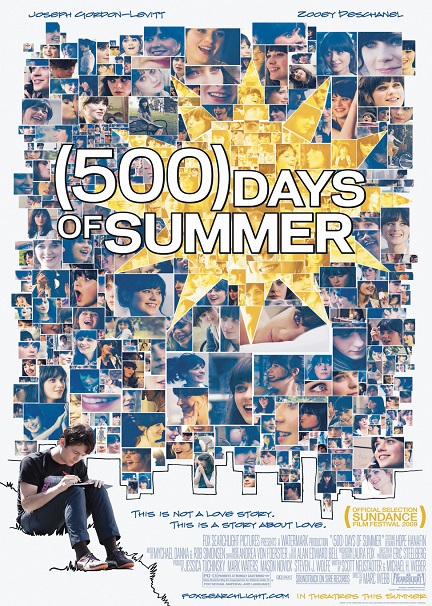
Cast of Characters:
Tom Hansen – Joseph Gordon-Levitt
Summer Finn – Zooey Deschanel
McKenzie – Geoffrey Arend
Rachel Hansen – Chloe Grace Moretz
Paul – Matthew Gray Gubler
Vance – Clark Gregg
Director – Marc Webb
Writer – Scott Neustadter & Michael H. Weber
Producer – Jessica Tuchinsky, Mark Waters, Mason Novick & Steven J. Wolfe
Distributor – Fox Searchlight Pictures
Running Time – 95 minutes
Rated PG-13 for sexual material and language.
Tom Hansen (Joseph Gordon-Levitt) is an aspiring architect who currently earns his living as a writer for an Los Angeles-based greeting card company. After meeting his boss Vance’s (Clark Gregg) new secretary, Summer Finn (Zooey Deschanel), Tom’s entire world is thrown into a whirlwind of hearts and tummy butterflies. She’s cute, charming and seemingly has everything in common with him. Cupid’s arrow must’ve nailed that bullseye, ’cause all it takes is Summer telling Tom she also loves music like The Smiths, and he’s instantly head over heels for her.
As Admiral Ackbar once said, “It’s a trap!”
Or better yet, as Tom’s sister Rachel (Chloe Grace Moretz) reminds him, “Just ’cause some cute girl likes the same bizarro crap you do, that doesn’t make her your soulmate, Tom.”
The pair hit it off, and things seem to be going just swell. But after seeing each other for a while, Tom quickly realizes there’s one very clear, fundamental difference between the two. He believes in the ideas of true love and soul mates, and is looking for a committed relationship. Summer, however, believes in none of that and is only wanting something casual.
And that, ladies and gentlemen, is what we call a fork in the road.
See? That funky-looking fish dude don’t lie.

Romantic comedies always face the difficult task in avoiding the numerous trappings many of its kind have fallen prey to. You’ve certainly seen them all before…
1) The climactic declaration of love in a public setting.
2) The misunderstanding that leads to a breakup, which leads to a montage of both parties being sad, which then leads to them getting back together at the end, usually be way of a public declaration of love.
3) Stopping the one they’ve always loved and were destined to be with forever at the last minute before the turn from the one true love to the one who got away. This is typically done at airports, train stations, bus station – hell, sometimes even their own weddings, where victory is achieved through, of course, another public declaration of love.
4) The bet or no strings attached pact that – go figure – leads to them actually falling in love, and once again, ends with another public declaration of love.
5) In any of these scenarios, the large onlooking crowd is optional, but more often than not, they are there, and they will, without a doubt, awe and ooh and applaud like crazy when the two lover finally lock lips.
Oh, and did I forget to mention the public declaration of love?

But when a rom-com works, it’s magic. There’s screwball romps of the Hollywood Golden Age such as It Happened One Night and The Philadelphia Story. There’s modern rom-coms like Broadcast News and When Harry Met Sally… that provide both sharp dialogue and well-drawn characters. Then you have inventive, way out of left field efforts like Annie Hall and Eternal Sunshine of the Spotless Mind that bring a refreshing level of creative originality to the genre.
And then we have (500) Days of Summer, which like those latter two films, is shamelessly offbeat and all the more wonderful because of it. And, honestly, it couldn’t have arrived at a much more needed time, being surrounded by the horrifying hellscape that was early to mid-2000s rom-coms: The Wedding Planner, Just Married, How to Lose a Guy in 10 Days, My Boss’s Daughter, Monster-in-Law, Failure to Launch, Because I Said So, 27 Dresses, Fool’s Gold, What Happens in Vegas, Ghosts of Girlfriends Past, The Ugly Truth.
Somebody please stop me before I shoot myself.
Yes, movies so inauthentic in their treatment of romance and, more importantly, so cripplingly unfunny, they’d turn even the most hopeless romantic into a cold-hearted cynic. But thankfully, (500) Days of Summer burst onto the scene with all its immensely appealing quirk and clever deconstruction and breathed some very badly needed new life into the awfully tired genre.
Unlike many of its rom-com contemporaries, (500) Days of Summer doesn’t play by the genre rules or sugarcoat a forced happily ever after ending. This film doesn’t end with wedding bells or another public declaration of love, and it wants to make clear that while this is a story of boy meets girl, this is not a love story. You know you’re in for a different take when the film opens with an author’s note stating: “The following is a work of fiction. Any resemblance to persons living or dead is purely coincidental… especially you Jenny Beckman… bitch.”
Not sure who this Jenny is or what she did, but she’s apparently a bitch.
From that opening disclaimer, we know that the boy isn’t getting the girl of his dreams, but it’s the journey to that destination, watching how it all started and how it all fell apart, that makes this film so engaging. Director Marc Webb and his team of writers, Scott Neustadter and Michael H. Weber, present the film in a non-linear format (all from Tom’s hyper-idealistic point of view) that cuts from one random day to another beautifully, thanks to Alan Edward Bell’s first-rate editing (a day counter is used, so as not to throw viewers off track). It’s as if we’re treated to a front-row seat inside the mind of a hopeless romantic recalling back fragmented memories of a past doomed relationship.
Another genre convention shakeup provided by Neustadter and Weber is the way they subvert our expectations of the rom-com’s gender roles. With most rom-coms, it’s typically the woman that’s all about commitment and hopeless romanticism, whereas the man is shallow, casual and non-committal. But here, Neustadter and Weber reverse the roles between Tom and Summer, he now being the head over heels one and she being all play and no emotional attachment. In doing so, the duo take a deconstruction hammer and completely shatter both the “Manic Pixie Dream Girl” and “Nice Guy” tropes. It’s a fun, unique spin on these role conventions that lends the film a great deal of its freshness.
At times, Webb indulges in a few flights of fancy that could’ve felt like a gimmick, but since this is told from Tom’s heavily rose-colored glasses POV, they work great here ’cause they’re moments viewers can immediately relate to (a similarly fanciful conceit was used with Ralphie’s POV in A Christmas Story). Tom may be delusional in his pursuit of Summer, but he’s also embarrassingly relatable. How many of us have finally gotten that first real relationship and felt like practically dancing in the streets, flash mob style to Hall & Oates’s “You Make My Dreams”? Or when it all comes crashing down, imagined ourselves as characters from Ingmar Bergman films as we drown away in our sorrows and curse the bitch for ever existing? Even when the lines between fantasy and reality begin to blur, Webb, Neustadter and Weber depict both the glorious highs and heartbreaking lows of love here with a much-needed dose of grounded reality and truth.

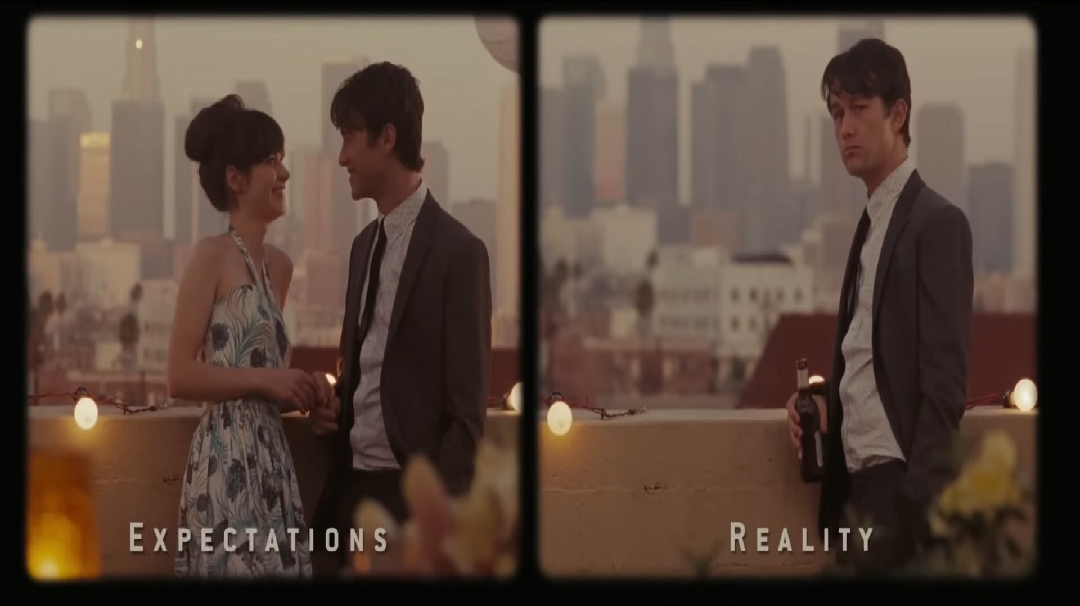
The big make or break factor of any rom-com all comes down to the chemistry between its two leads. Thankfully, Joseph Gordon-Levitt and Zooey Deschanel generate chemistry together in spades, and deliver some of the finest work of their respective careers. As Tom, Gordon-Levitt hits all the right notes as the likable fool in love who’s easy to please and thus easy to break over his crazy notion that Summer is, in fact, “the one” (there’s a split-screen representation between Tom’s expectations vs. reality that’s brutally poignant). As the object of our lead hopeless romantic’s affection, the charming and so gosh darn adorable Zooey Deschanel is sweet, smart, uncompromisingly honest and fiercely independent, bringing exactly the right presence and personality to embody a character like Summer.
In lesser hands, Tom and Summer could’ve been transformed into dreadfully unlikable caricatures. I can only imagine the failed version of this where Tom goes from hopeless romantic to insufferable dick and Summer goes from emotionally detached to malicious bitch. Yet Gordon-Levitt and Deschanel never resort to turning the two into a question of who’s right and who’s wrong, despite the Team Tom vs. Team Summer camps that seemed to have developed following this film’s release. Tom’s not an irredeemable loser, nor is Summer a cold-hearted villain. Tom’s right to believe in love and we feel for his frustration over Summer’s lack of interest in a committed relationship, some of which boils up into some hysterically funny moments, particularly two contrasting monologues that starts with what he loves about Summer and ends with what he hates about her. However, he also refuses to respect the boundaries Summer clearly stated to him the very moment they got together. Likewise, we also understand how past heartbreak tainted Summer’s view of relationships, which has made her hesitant to take that next step. But in fairness to Tom, her carefree, go with the flow, I do what I want attitude has her often being oblivious to the pain her aloofness causes, most notably in the way Tom calls her out for wanting to enjoy the perks of a relationship without actually committing to being in one.
So, yeah, they’re both emotionally immature, but does that make either of them villains? No, it makes them human, and the film wisely treats them as such, flaws and all. Like all young adult idiots, both Tom and Summer have distorted perceptions of love and think they know for sure what they want. But as the film progresses, they learn the way love works isn’t always black and white, nor is it neat and tidy, nor does it occur exactly as planned. It’s this kind of attention to character growth that elevates (500) Days of Summer from a fun, quirky and whimsical rom-com into something profoundly beautiful, even if it’s not the ending we may have hoped for at the beginning.
Ultimately, this is a perfect example of an ending viewers may not want, but it’s an ending the story needs.
Or better yet, to quote Summer, “I just kept thinking, ‘Tom was right’… it just wasn’t me that you were right about.”
Closing Statement: Stylishly absurd, hilarious and painfully honest, (500) Days of Summer is a remarkable feature-film debut from director Marc Webb that benefits tremendously from Scott Neustadter and Michael H. Weber’s razor-sharp, insightful script and two pitch-perfect performances from Joseph Gordon-Levitt and Zooey Deschanel. At a time when studio rom-coms were drowning in cliches and inauthenticity, this charming little gem rose above that dreck and revitalized the genre, remaining to this day as one of the best romantic comedies of the twenty-first century.
Silver Screen Fanatic’s Verdict: I give (500) Days of Summer an A+ (★★★★).
Benjamin’s Stash Tier: Diamond Stash
About Post Author
