
28 Years Later
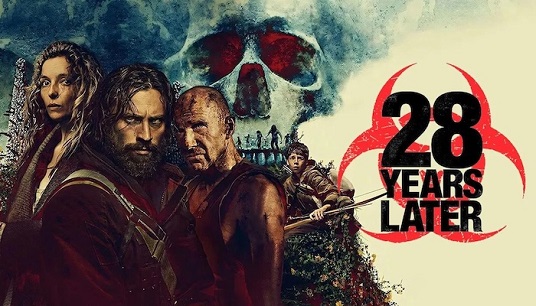
Cast of Characters:
Isla – Jodie Comer
Jamie – Aaron Taylor-Johnson
Sir Lord Jimmy Crystal – Jack O’Connell
Spike – Alfie Williams
Samson – Chi Lewis-Parry
Dr. Ian Kelson – Ralph Fiennes
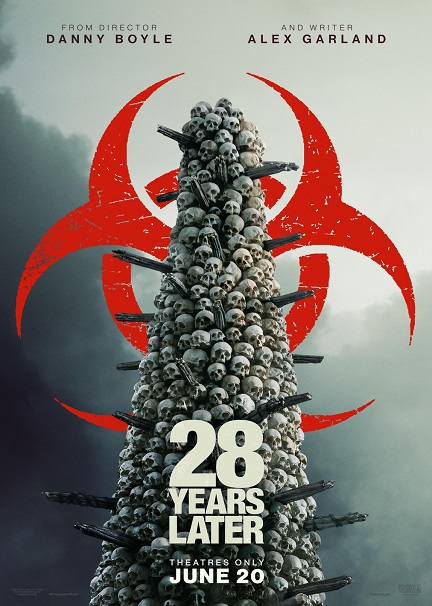
Director – Danny Boyle
Writer – Alex Garland
Producer – Andrew Macdonald, Peter Rice, Bernard Bellew, Danny Boyle & Alex Garland
Distributor – Sony Pictures Releasing
Running Time – 115 minutes
Rated R for strong bloody violence, grisly images, graphic nudity, language and brief sexuality.
In 2002, right at the onset of the Rage Virus outbreak, a young boy, Jimmy Crystal (Rocco Haynes), flees his home in the Scottish Highlands as his family is attacked by the infected. He takes refuge in the local church led by his minister father, but soon after finds that shelter under attack. Though he is able to escape, his father willingly stays behind to be taken down by the infected, and the Rage Virus spreads further.
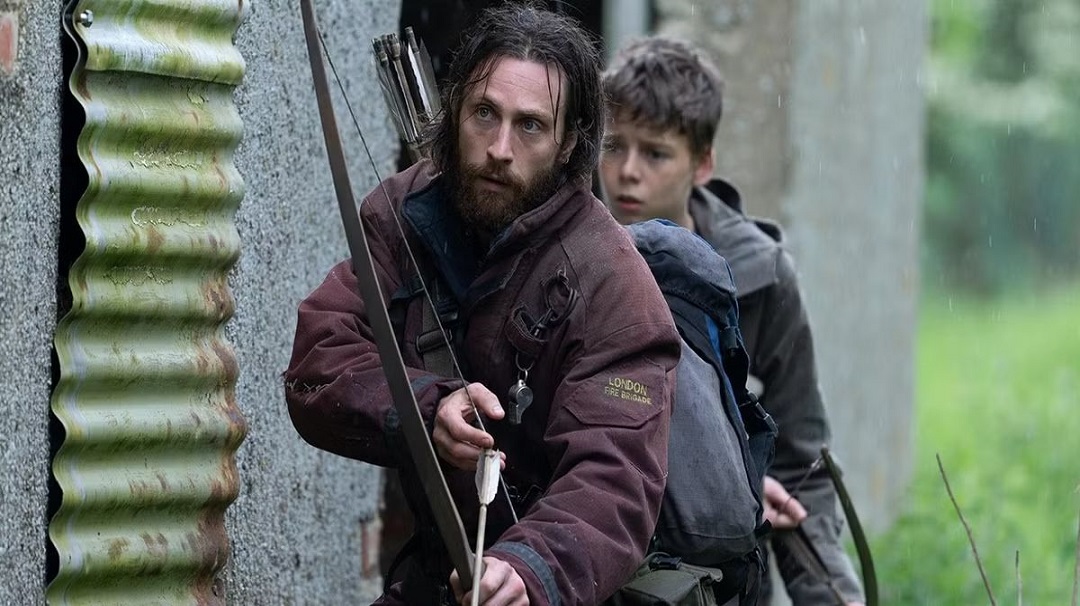
Twenty-eight years later, the Rage Virus has been successfully driven out of continental Europe, leaving the few survivors left on the British Isles under indefinite quarantine. One community of survivors live on the Holy Island of Lindisfarne, which is guarded naturally by a long causeway that floods with the tide. Among them is Jamie (Aaron Taylor-Johnson), his debilitated wife Isla (Jodie Comer) and their 12-year-old son Spike (Alfie Williams). Spike sees hope in getting medical care for his mom when he learns of Dr. Ian Kelson (Ralph Fiennes), a former general practitioner living in exile on the British mainlands. However, Jamie rejects the idea, believing Dr. Kelson to be insane and dangerous.
Despite his dad’s warnings, Spike is determined to get his mom the care she needs, and when the tide clears, he and Isla escape the island. Now on the mainland, the two will brave the infected, including a far more evolved “Alpha” (Chi Lewis-Parry), in order to reach the doctor.
28 Years Later is a fitting title for the third entry of the 28 Days Later film series, not just for the passage of time in its narrative, but also for the time the project itself had languished in development hell. This is a film that was nearly twenty years in the making, going as far back as summer of 2007 when Fox Atomic confirmed development on a third film following the financial success of 28 Weeks Later. After a myriad of production delays and legal issues involving film rights, both director Danny Boyle and writer Alex Garland confirmed in early 2024 that 28 Years Later was finally in development, with 28 Days Later star Cillian Murphy also signing on as an executive producer. Additionally, 28 Years Later was not only intended to be the next entry in the series, but also the beginning of a planned trilogy of sequels, making it somewhat of a series within a series.
Undoubtedly, the expectations for 28 Years Later were astronomically high. It wasn’t just that it was resuming the series now eighteen years after 28 Weeks Later and twenty-three years after 28 Days Later, it also had to redeem the series from a previous film that many saw as a huge disappointment. Even I, as someone who still enjoys 28 Weeks Later, fully concede that it’s a step down from the landmark 2002 film.
It’s undeniable that since it’s release, Boyle and Garland’s return to the franchise has polarized fans. Of course, there’s the infamously jarring conclusion (which actually serves as a set up for its successor), and the lack of fast-paced, action-packed horror definitely irked those that clearly mistook 28 Days Later for Resident Evil. But I say to hell with all the scorn and derision, ’cause 28 Years Later is a riveting, two decades in the making comeback for the iconic horror franchise.
For 28 Years Later, Danny Boyle takes the franchise’s visual style back to the beginning. Gone is the slick, summer blockbuster feel of 28 Weeks Later, which while still fun and impressive looking, was a tonal and aesthetic shift that felt alien to 28 Days Later. Here, Boyle reunites the franchise with the grounded, “guerrilla-style”, low-fidelity vibe that distinguished the original film, resulting in a far more visceral and intimately tense experience (the use of Rudyard Kipling’s “Boots” mixed with archival wartime footage is an extremely effective touch that adds to the film’s haunting atmosphere).
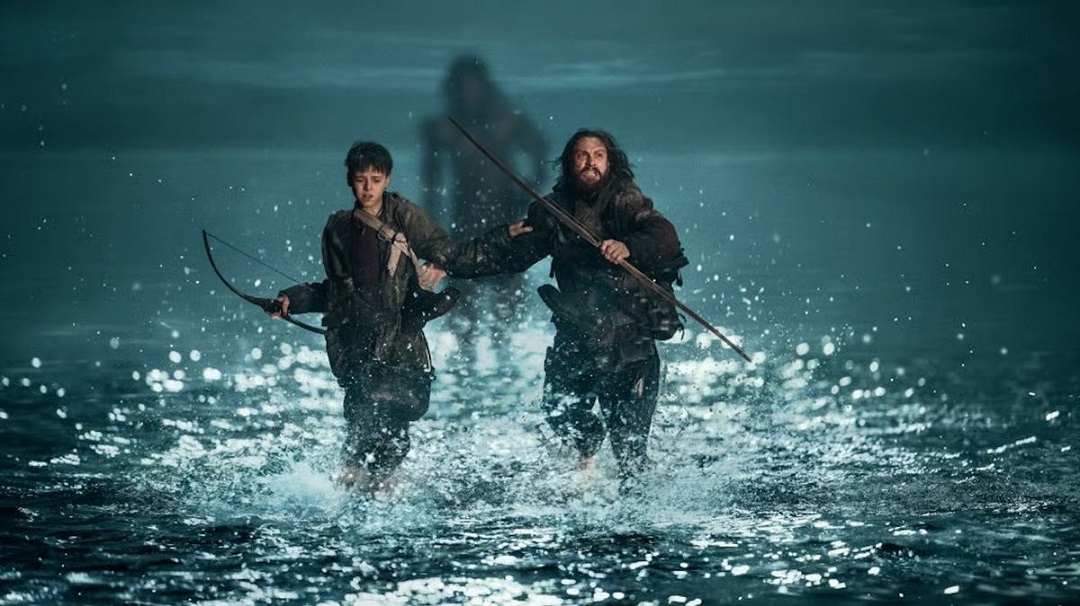
As he did so brilliantly with the first film, Boyle utilizes innovative techniques to create an immersive sense of atmosphere and tension, working with his go-to cinematographer Anthony Dod Mantle to employ custom-made rigs with twenty mounted iPhones for 180-degree action shots. This, coupled with Jon Harris’s frenetic editing, produces what Boyle refers to as a “poor man’s bullet time” effect, a thrilling combination of time slices and freeze frames that heighten the horror sequences, most notably among them an intense, edge-of-your-seat chase across the flooded causeway.
Bonus props to the score by Young Fathers too, ’cause their remix of Richard Wagner’s “Vorspiel” is a pitch-perfect cherry on top of that terrifying chase.
By this point in similar dystopian franchises, we typically are presented with the outbreak’s widespread global impact (something that 28 Weeks Later’s ending hinted at). However, Alex Garland’s script takes a sharp turn in the other direction and shifts its focus on a small group of survivors. Serving as an allegory for modern British isolationism, the film explores the psychological and emotional toll placed on a society that has now lived on for a full generation since the start of the outbreak. The Rage Virus has now long been their “new normal”, much in the same way our world today has adults that have lived entirely in a post-9/11 world and elementary-age children that have lived entirely in a post-COVID world.
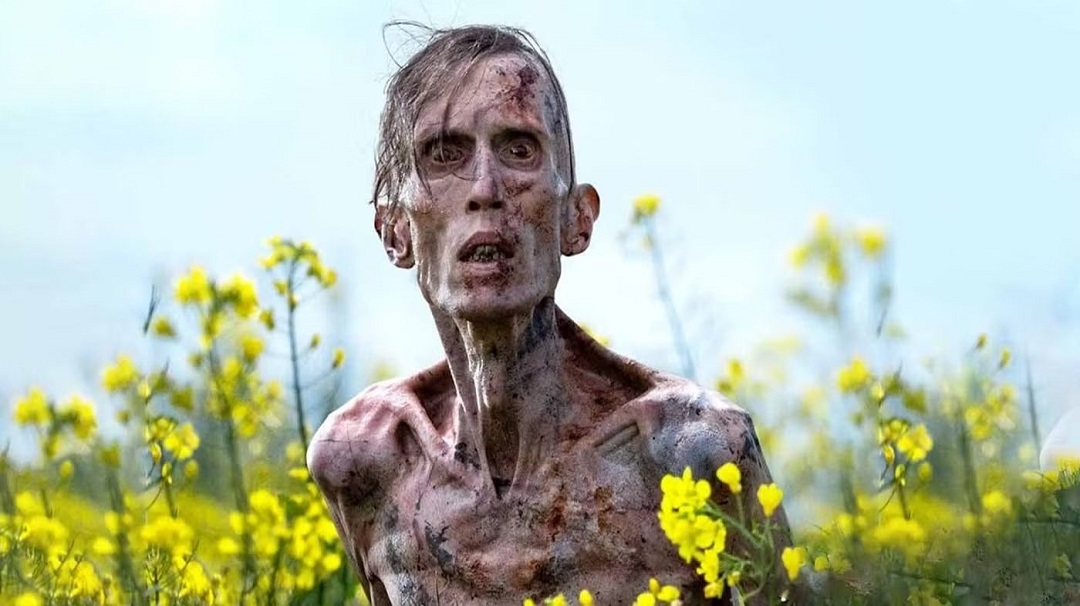
Equally fascinating are the new tweaks Garland provides to the infected, who appear to have evolved over the course of nearly three decades. Of course, some remain the same and some have seemingly de-evolved into pitiful, wormlike “ghouls”. But many of them have evolved into forming tribes, led by Alphas (the main one being played with frightening ferocity by Chi Lewis-Parry) who aren’t exactly the easiest to put down and have, let’s just say a rather gnarly go-to move on their prey. Additionally, the introduction of a pregnant infected further suggests possible formations of family units, while also raising intriguing questions when its discovered that those born from the infected aren’t infected themselves.
As Dr. Ian Kelson simply puts it, “How interesting… the magic of the placenta.”
Just keep that magic away from Tom Cruise.
But despite all its grim, post-apocalyptic dreariness, 28 Years Later is fundamentally a melancholic coming-of-age tale through the eyes of the twelve-year-old Spike told in two acts. The first centers on Spike’s relationship with his father, who’s desperate to transition his son into manhood by way of a very traumatic rite of passage. The second finds 28 Years Later almost turning into an entirely different movie as it follows Spike on his journey to save his ailing mother. It’s that mid-point shift where the film transforms from sheer survival horror into a deeply profound mediation on grief and the preciousness of mortality. It’s a bold move by Boyle and Garland to go for that drastic of a story change-up, but Boyle is certainly no stranger to experimenting with wild tonal swings, and it’s ’cause of his sure hand that the film not only doesn’t crash and burn in the second half, it’s elevated into something truly special. Not often are survival horror and tearjerker paired together in the same sentence, but the film dares to explore emotional depths not yet traversed in the franchise, and in doing so earns every one of those tears.
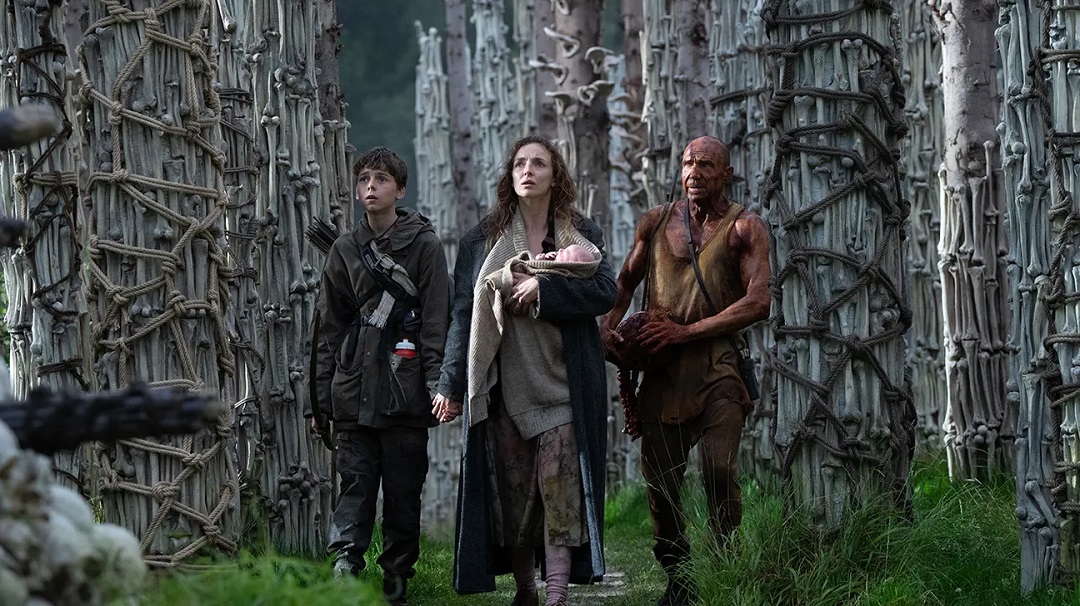
The cast is uniformly excellent here. Jodie Comer delivers a devastatingly empathetic performance as Isla, Spike’s mother who not only has to battle the infected but also her own debilitating illness. Comer’s tasked with handling an wide spectrum of character shifts. There’s extreme, illness-induced hysterics, then tender moments shared with her son, followed by a pivotal moment on an abandoned train that proves she still possesses more resilience and agency than her illness lets on. It’s a role that could’ve easily flown right off the tracks, yet Comer nails each transition with nary a misstep. Aaron Taylor-Johnson also turns in great work as Spike’s deeply flawed yet protective father Jamie. Despite not getting as deep an arc as his co-star Comer, Taylor-Johnson manages to strike a balance between rugged bravado and masked vulnerability that effectively conveys his character’s burden in dealing with his wife’s long-term illness in addition to surviving the virus.
As the aforementioned Spike, Alfie Williams gives a breakout performance that serves as the film’s main emotional anchor, a feat made even more impressive in that it’s his feature film debut. Williams brings such emotional authenticity to Spike’s inner conflict, a boy caught between choosing to follow his father’s footsteps or forge his own path. His later scenes opposite Jodie Comer and Academy Award nominee Ralph Fiennes, however, is where his performance really shines. Despite some heartbreaking turns, it’s those moments that ultimately provide a beautiful and hopeful counterpoint to the Rage Virus carnage that surrounds them.
And speaking of Fiennes, that man doesn’t show up until late in the game, but God bless him, somehow still manages to steal the entire movie as the eccentric Dr. Ian Kelson. Of course, one look at that shaved head and iodine-soaked body and you initially get why people shun him as some sort of mad scientist, yet Fiennes brings such a sweet and nurturing quality to Dr. Kelson that shatters every single ill-conceived perception about him and his bone temple (exquisitely designed by Carson McColl and Gareth Pugh). It’s when you finally hear the meaning behind Kelson’s monument and how it’s built with both infected and non-infected alike “because they are alike” that you then realize the doctor and his morbid home decor ultimately embody the beauty found at the core of this film, “Memento Mori… Memento Amoris.”
“Remember you must die… Remember you must love.”
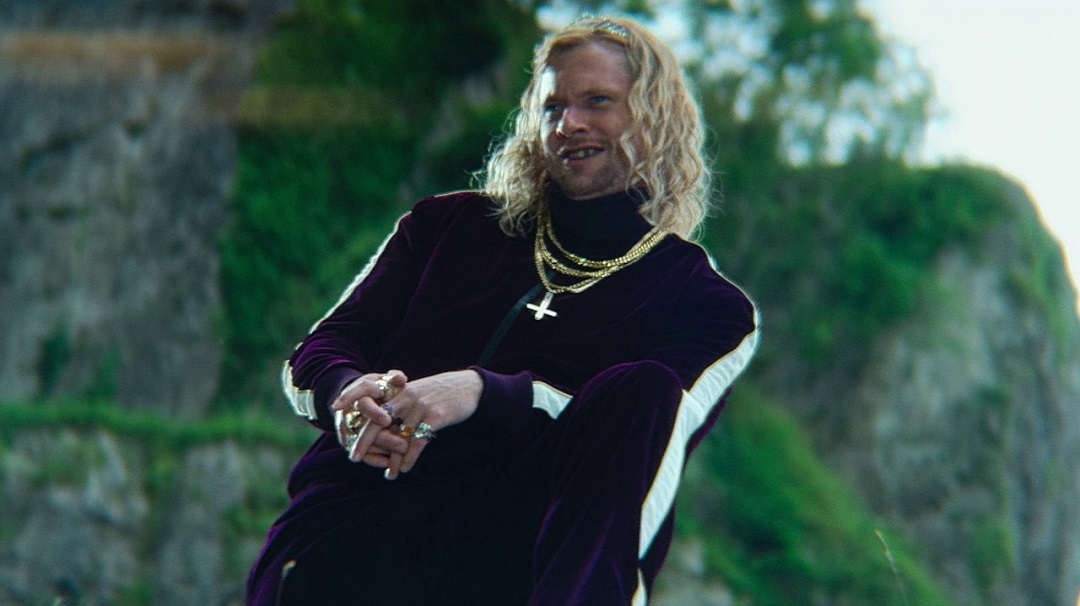
Of course, there’s the ending, which has sharply divided viewers for what appears to be a jarring tonal shift toward the absurd. It’s there where we’re finally introduced to a band of colorfully-adorned goons led by an adult Jimmy, now known as Sir Lord Jimmy Crystal (played chillingly by Jack O’Connell). Given the gang’s love for multi-colored tracksuits, you’d be forgiven for mistaking their fashion statement as a nod to the Power Rangers or Teletubbies (especially the latter, considering what a young Jimmy was watching during the intro). However, it’s actually a nod to former English media personality Jimmy Savile, and if you know anything of his sordid history, that makes the gang all the more despicable.
And only slightly less depraved than the Teletubbies.
Granted, when I first saw the film, I admit to feeling a touch taken aback by the shift, at least initially. But it’s clear that 28 Years Later’s ending is not a definitive conclusion, but rather a setup for the next film. Jarring as it may be, though, knowing what takes place at the beginning of the movie, this film’s ending still stands on its own as a logical, albeit highly unsettling, bookend that highlights the franchise’s overall point.
The true monsters have never been the infected.
Closing Statement: Brimming with haunting atmosphere, ferocious tension, and emotional resonance from two standout performances by Jodie Comer and Ralph Fiennes, 28 Years Later returns to its kinetic roots with director Danny Boyle and writer Alex Garland at the helm, delivering a visceral experience that is every bit as poignant as it is terrifying.
Silver Screen Fanatic’s Verdict: I give 28 Years Later an A (★★★½).
Benjamin’s Stash Tier: Platinum Stash
About Post Author
