
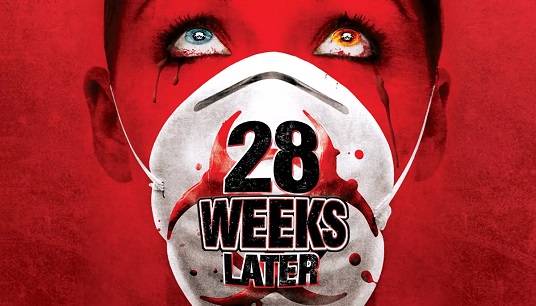
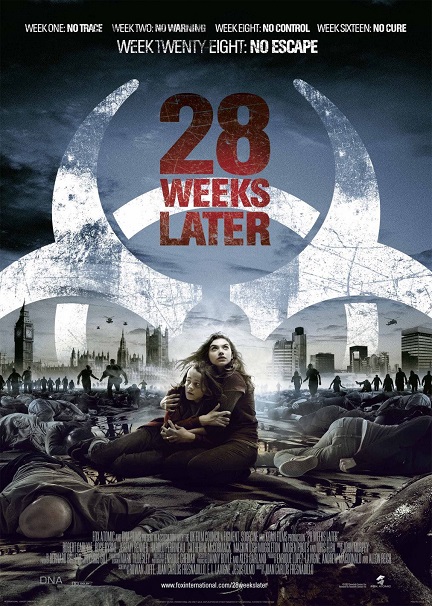
28 Weeks Later
Cast of Characters:
Don Harris – Robert Carlyle
Maj. Scarlet Levy – Rose Byrne
Sgt. Doyle – Jeremy Renner
Flynn – Harold Perrineau
Alice Harris – Catherine McCormack
Andy Harris – Mackintosh Muggleton
Tammy Harris – Imogen Poots
Gen. Stone – Idris Elba
Director – Juan Carlos Fresnadillo
Writer – Rowan Joffe, Juan Carlos Fresnadillo, E. L. Lavigne & Jesus Olmo
Producer – Enrique Lopez-Lavigne, Andrew Macdonald & Allon Reich
Distributor – Fox Atomic
Running Time – 99 minutes
Rated R for strong violence and gore, language and some sexuality/nudity.
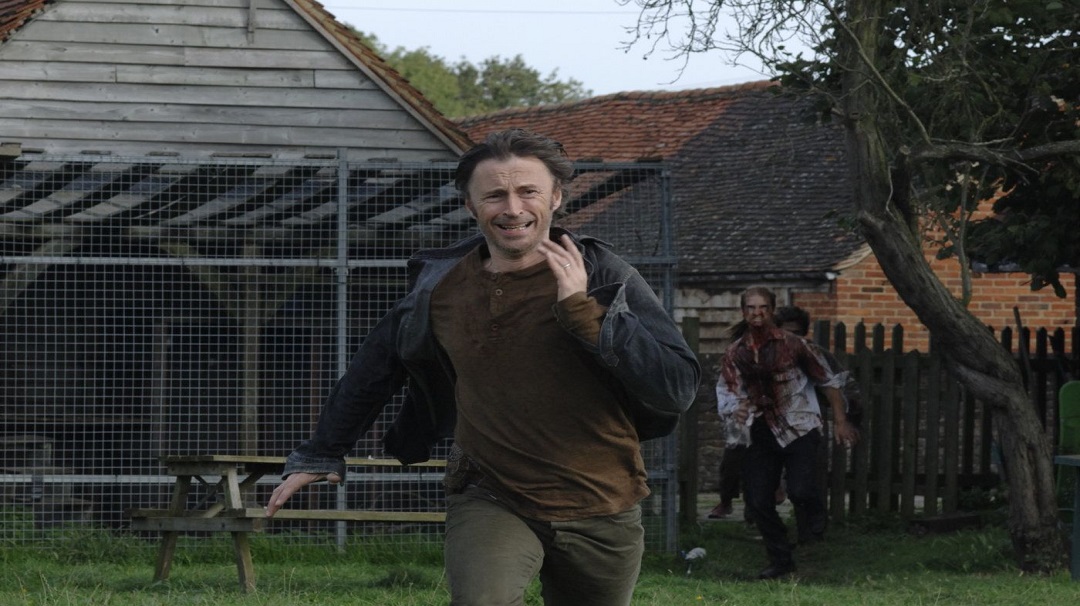
During the initial outbreak of the rage virus, Don Harris (Robert Carlyle) and his wife Alice (Catherine McCormack) have taken shelter in a fortified cottage on the outskirts of London. After rescuing a young boy from outside, they are attacked by the infected who have followed the boy. Alice tries to save the boy from the horde, but Don insists that child had a good run, so just leave him.
I mean, it’s not like it’s his kid or anything. What kind of animal would just straight up abandon his actual family?
Turns out Don’s that kind of animal, ’cause after his wife is cornered by the infected while searching for the child, he just up and leaves her behind.
‘Cause when he promised to love her ’til death do them part, he assumed that also meant if he allows for the death to happen.
Twenty-eight weeks after the outbreak, the U.S. military, under the command of Gen. Stone (Idris Elba), has been bringing settlers into a heavily guarded safe zone on the Isle of Dogs named District One. It’s there that Don reunites with his children, Tammy (Imogen Poots) and Andy (Mackintosh Muggleton), who were overseas on a school trip during the outbreak. Since we already know he has no problem leaving his family for dead, it should come as no surprise that he straight-up lies to his children about their mother.
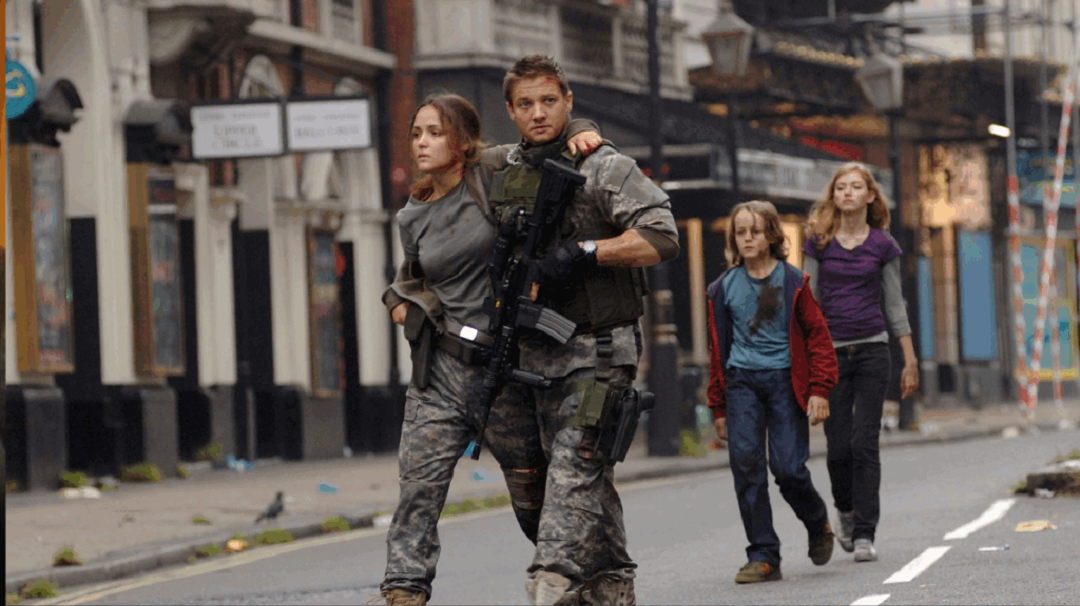
Of course, that lie eventually gets uncovered when Tammy and Andy sneak out to visit their old home only to find that their mom is alive but in a highly delirious state. After the three are returned to District One, they are examined in quarantine by U.S. medical officer Scarlet Levy (Rose Byrne), who learns that Alice is an asymptomatic carrier of the rage virus. Because of Alice’s genetic immunity, Scarlet believes she and her children may possess a potential cure to the virus. But when the region gets hit with another inevitable outbreak, that pathway to a cure is hindered by Gen. Stone’s determination to quell the infected mayhem by any means necessary.
2002’s 28 Days Later was the jolt of electricity zombie films needed to reanimate the horror sub-genre back to life. Combining intensely unsettling tension with sharp social commentary, the Danny Boyle-directed flick single-handedly revolutionized zombie horror for the 21st century. And viewers clearly agreed, giving the film a total worldwide run of $82 million on a small production budget of just $8 million. So, no surprise, Boyle, writer Alex Garland and producer Andrew Macdonald were set to make a sequel four years after the first film. However, Boyle’s commitment to Sunshine prohibited him from returning, though both he and Garland would stay on as executive producers. Stepping into the director’s chair this time would be Spanish filmmaker Juan Carlos Fresnadillo, who was fresh off a five-year hiatus from filmmaking to work on TV commercials.
Since its release, 28 Weeks Later has gone on to be viewed like the red-headed stepchild of the franchise. But following a groundbreaking first film for any sequel is no easy feat, and it’s unfair to place “similar greatness or bust” expectations on them. I get that there are sequels that totally miss the mark. Caddyshack II is not only not as great as the first film, it also sucks balls. At the same time, though, not every sequel needs to be The Godfather Part II, Dawn of the Dead, The Empire Strikes Back or The Dark Knight. If it’s able to hit that mark, great, but in reality, all you really ask for is that it’s at least good. For sure, 28 Weeks Later doesn’t match the impact delivered by its predecessor. It’s messy (rewrites from four credited writers and some uncredited touch-ups from Alex Garland will do that), lacks the sharp commentary and progresses the story through the “idiot plot” more than it should. That said, Fresnadillo delivers enough of the horror goods to keep things entertaining, even though it falters in places.
Much like a comedy’s faults can be forgiven if it can still manage to be funny, a horror film’s faults can be forgiven if it still manages to be tense and thrilling.
Most of the divisive response to this film can be attributed to its radical stylistic shift from its predecessor. 28 Days Later was a gritty, character-driven horror allegory that used zombie conventions to explore thought-provoking ideas, but ultimately wasn’t really a zombie film. 28 Weeks Later, on the other hand, is a slicker, action-heavy, plot-heavy blockbuster that trades realism for straight-up zombie horror (best exemplified by a goofy, out-of-place sequence where a helicopter uses its blades to mow through an infected horde). In fact, one wonders if the response would’ve been more forgiving if the film divorced the “28” of it all from its title.
But on its own merits, 28 Weeks Later succeeds more than it fails. Fresnadillo comes right out of the gates guns blazing with a fantastic opening sequence, a flashback to the start of the outbreak that plays out like the frantic offspring of Night of the Living Dead and Force Majeure (28 Years Later would continue this introductory structure with its own flashback to the start of the outbreak). From there, the film keeps its engines running at full-throttle, delivering a handful of relentless, visceral action set pieces. Whether it’s a terrifying civilian lockdown that quickly turns deadly, a visually thrilling carpet-bombing sequence, or a white-knuckle set piece that utilizes a rifle’s night vision scope as a POV through a ravaged London Underground, Fresnadillo continually keeps the proceedings engaging if not particularly deep. For what faults it may have, being dull isn’t one of them.
Not that this film is entirely without any attempt at exploring thought-provoking themes like its predecessor. It may not nail the landing like the first film did, but it at least flirts with some interesting ideas like militarism and moral compromise made in the name of security, the latter of which culminates in a crucial decision by Idris Elba’s Gen. Stone that the film, to its credit, leans all the way in on.
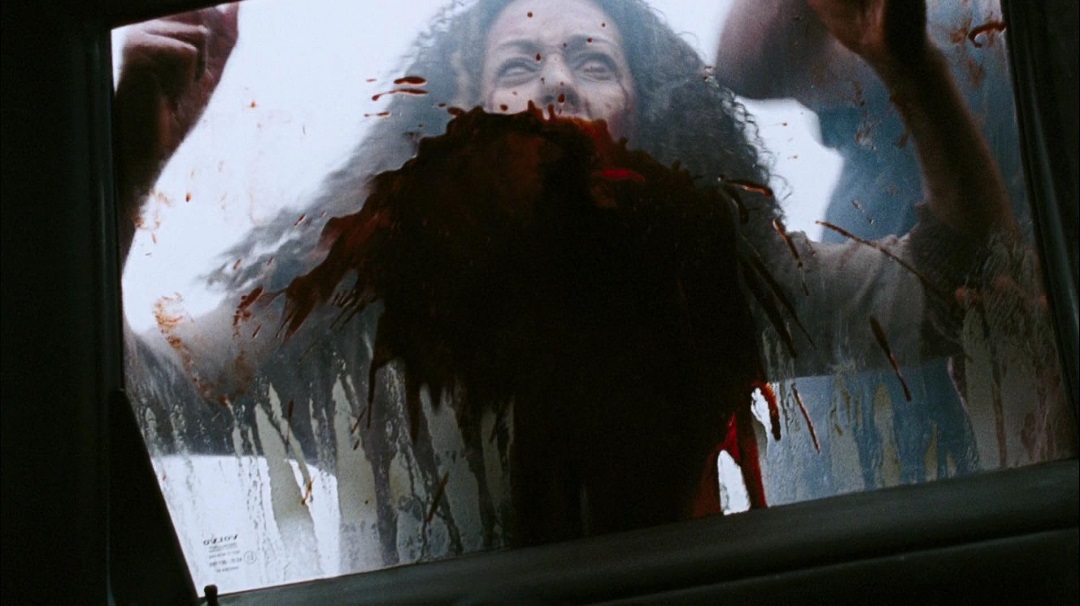
Much like the talent behind the camera, 28 Weeks Later features fresh faces in front of it as well, including a pre-famous Rose Byrne, Imogen Poots and Academy Award nominee Jeremy Renner. Both Byrne and Renner don’t get much to work with on paper. Byrne, in particular, gets saddled with much of the clunky, expository dialogue. Still, the two are able to rise above their characters’ deficiencies with fine performances that’d soon pave the way for the stars they’d eventually become. Idris Elba is underutilized as the hardened, no-nonsense Gen. Stone, but still injects enough of his unique cool swagger and smooth gravitas to make the very cliche character an engaging presence, even if only for a limited time. Robert Carlyle (who previously worked with Danny Boyle on Trainspotting) gets the most to chew on with his performance as the morally conflicted Don Harris. While Don certainly makes some horrible choices, especially regarding his wife, Carlyle conveys an effective sense of vulnerability and guilt that helps turn a character you’d normally want to hate into someone far more tragic.
Over the years, Imogen Poots and Mackintosh Muggleton seem to have gotten the brunt of the criticism for the many, let’s just say highly questionable decisions their characters make. Obviously, that makes sense knowing that kids always make wise, rational and clearly thought-out choices (the script is far from perfect, but I do excuse it for making kids do very immature, selfish kid things). That aside, both are quite good here, and with a good chunk of the plot revolving around them, they’re up to the task in helping carry it. Poots, in particular, delivers standout work that requires her to hit a wide array of emotional beats, and she nails each one capably. Like Byrne and Renner, her performance here would serve as a stepping stone to bigger and better turns later on in Green Room, The Art of Self-Defense and The Father.
Closing Statement: 28 Weeks Later is definitely a step down from its landmark predecessor, but despite not packing the same bite, this sequel generates enough thrills from a talented cast and effective zombie chaos to make it a flawed but worthy follow-up.
Silver Screen Fanatic’s Verdict: I give 28 Weeks Later a B (★★★).
Benjamin’s Stash Tier: Bronze Stash
About Post Author
