
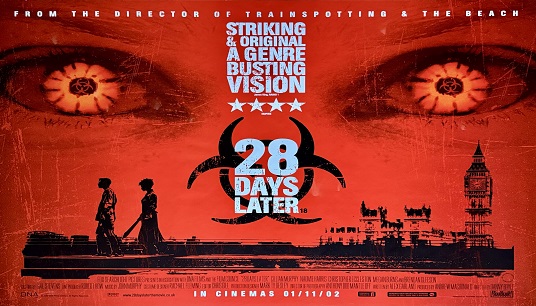
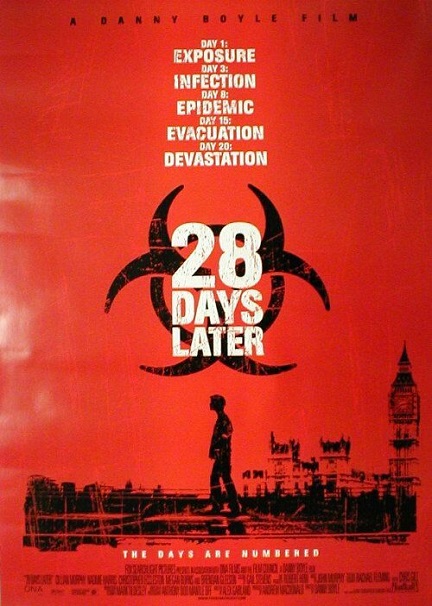
28 Days Later
Cast of Characters:
Jim – Cillian Murphy
Selena – Naomie Harris
Maj. Henry West – Christopher Eccleston
Hannah – Megan Burns
Frank – Brendan Gleeson
Director – Danny Boyle
Writer – Alex Garland
Producer – Andrew Macdonald
Distributor – Fox Searchlight Pictures
Running Time – 113 minutes
Rated R for strong violence and gore, language and nudity.
A group of animal rights activists break into a Cambridge laboratory that is home to some highly aggressive chimpanzees. Despite adamant warnings from a scientist that the apes are infected with a highly contagious “rage” virus, the activists are freeing those animals come hell or high water. When one of them manages to free a chimp, it attacks her, ‘causing her to quickly succumb to the virus. Of course, she then attacks the others, leading to a virus that has rapidly spread across Great Britain.
If only someone was there to warn them.
Twenty-eight days later, a bike courier named Jim (Cillian Murphy) wakes up in London’s St. Thomas’ Hostpial, following a traffic accident that had left him in a coma prior to the outbreak. He’s surprised, though, to find the entire area deserted. Not just the hospital, but the entire city of London. Completely abandoned. No sign of life. It’s now essentially a ghost town.
Orrrr is it?
It doesn’t take Jim long to find out that he’s not entirely alone when he discovers those left behind during the mass evacuation have been infected by the virus. After being rescued by another survivor, Selena (Naomie Harris), they band together and eventually find their way to a shelter belonging to cab driver Frank (Brendan Gleeson) and his daughter Hannah (Megan Burns). Frank discovered through a radio broadcast that there is a secured safe haven just outside Manchester, and is intent on taking his daughter there. Jim and Selena agree to tag along as well, but together, they’ll have to make their way through hell on earth first before reaching safety.
By 2000, the zombie genre was as good as dead. We were now fifteen years removed from George A. Romero’s Day of the Dead, and if, by chance, any zombie flick did happen to pop up in between that time, it certainly wasn’t generating any buzz. Not by critics. Not by viewers. And certainly not at the box office.
Then, in 2002, 28 Days Later arrived and completely changed everything.
Despite writer Alex Garland having cited Romero’s Night of the Living Dead and Dawn of the Dead as influences on his script, Oscar-winning director Danny Boyle hesitated to consider 28 Days Later a zombie film, at least initially. You could make the argument either way. This isn’t a zombie film in the traditional sense. The infected are still alive and not undead. They don’t have a voracious appetite for human flesh or “braaaaaaaains”, and appear to only show symptoms of aggression. They’re still humans… just really, really, really, really pissed off humans.
But they still bite people and spread infection too, so, like I said, it can go either way.
One thing is for certain, though, and that is 28 Days Later’s influence on the zombie genre is undeniable. It completely reinvigorated the genre, bringing about a complete redefinition of the creature that would continue on in Zack Snyder’s 2004 Dawn of the Dead remake, Paul W. S. Anderson’s Resident Evil franchise, World War Z, Train to Busan and the TV shows The Walking Dead and The Last of Us. Gone were the lumbering monsters, and taking their place were fast, rage-fueled cannibals.
Yes, as if you didn’t have enough to fear when they were still slow. Now, those creepy bastards added running and unstoppable rage to their list of horrifying strengths.
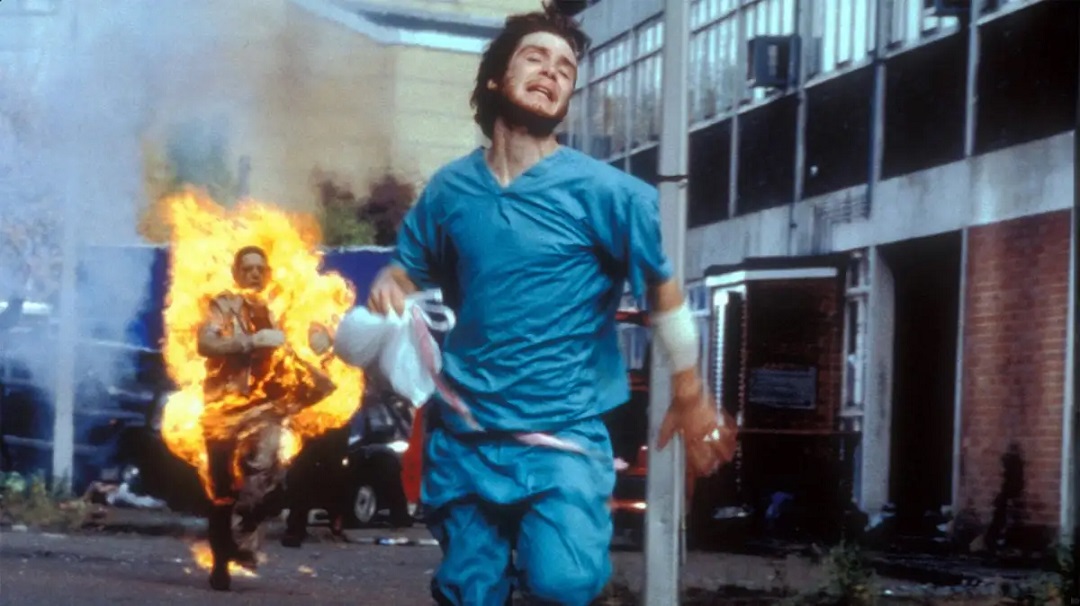
What makes Boyle and Garland’s approach to the genre so unique isn’t just their new, turbo-charged take on the zombie, but also setting’s realism. 28 Days Later strips away any semblance of the supernatural that you often got in zombie films before it, and instead paints a stark and gritty post-apocalyptic landscape that’s grounded in reality. It’s that all too real vibe that serves to amplify the film’s horror. Of course, since then, that style has been milked to death, but at the time, it was a novel approach.
Boyle wastes no time setting up what’s at stake here, delivering a quick conflict-establishing intro that explains all it needs to and then it’s off the races, with the director’s trademark kinetic flair being perfectly tailor-made to deliver the film’s strongly effective sense of chaos. Cheap thrills are avoided in favor of pervasive dread that carries on throughout the film and never lets up, especially during a white-knuckle, grip your armrest tight moment when Frank has to quickly change a flat tire in an abandoned tunnel before the infected horde reaches them. First come the rats, then the infected, and in a nice touch by Boyle and his longtime cinematographer Anthony Dod Mantle, the infected are presented not in person but with their ominous shadows illuminated on the tunnel walls, growing larger as they race closer to the car.
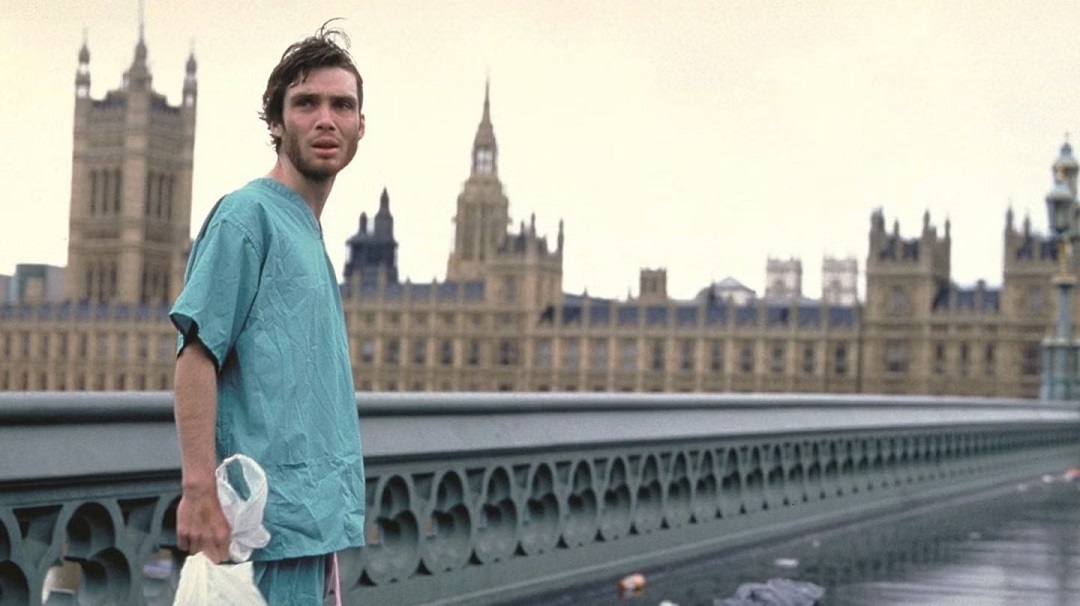
Of course, when talking about 28 Days Later set pieces, you have to mention one of the film’s most iconic set pieces where Jim wanders through an deserted London, an opening sequence made all the more impressive in that no CGI was used. Boyle went full guerrilla filmmaking for that entire sequence, utilizing Sunday shoots at dawn with minimal crew, along with cooperation from the police and pedestrians, to transform London into a desolate, virus-ravaged hellscape. Add to that Jim’s lone cries of “Helloooooooo?!” echoing through a deafeningly silent capital city like an eerie calm before the storm, and you have a landmark moment for 21st century horror that hits with an unsettling impact.
Scenes like that are proof that while CGI certainly has its place in film, you just can’t beat practical when it comes to realism.
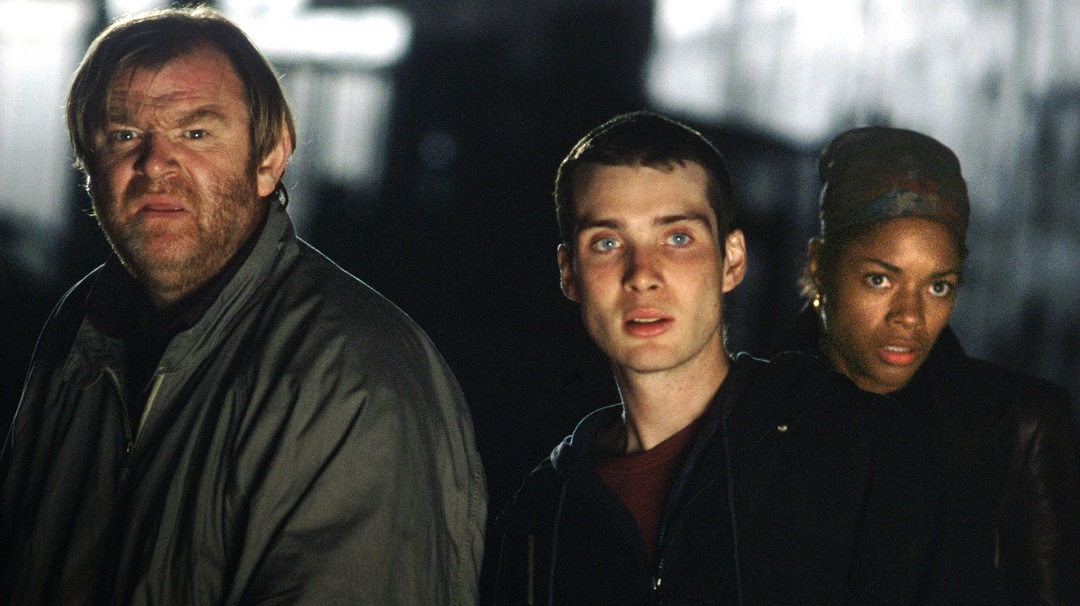
28 Days Later mines horror not just from the infected but also through the commentary in its story, which has long been a staple of the best offerings from the zombie genre. 1943’s I Walked with a Zombie explored slavery and racism. Night of the Living Dead was Romero’s allegory for the Vietnam War and other social tensions of that era. Its sequel Dawn of the Dead satirized consumerism and materialism. South Korea’s Train to Busan explored class divisions. Even the horror comedy Shaun of the Dead uses the zombie genre as a backtop for examining its title character’s relationships. Here, Garland’s script explores both societal collapse and the nature of rage through the lens of a post-9/11 world, letting the zombie outbreak serve as a metaphor for the anxieties and social unrest that rise when institutional authority begins to break down, and then the desperate measures said authority will take to maintain order.
These examinations become fully realized when our protagonists finally reach the broadcasted compound outside Manchester, led by Maj. Henry West. Adhering to the often-used zombie trope of “avoid the dead, beware the living”, 28 Days Later shifts our concerns from the infected to the compound leaders, asking the question of whether we should be scared of the infected or those we entrust to protect us from them.
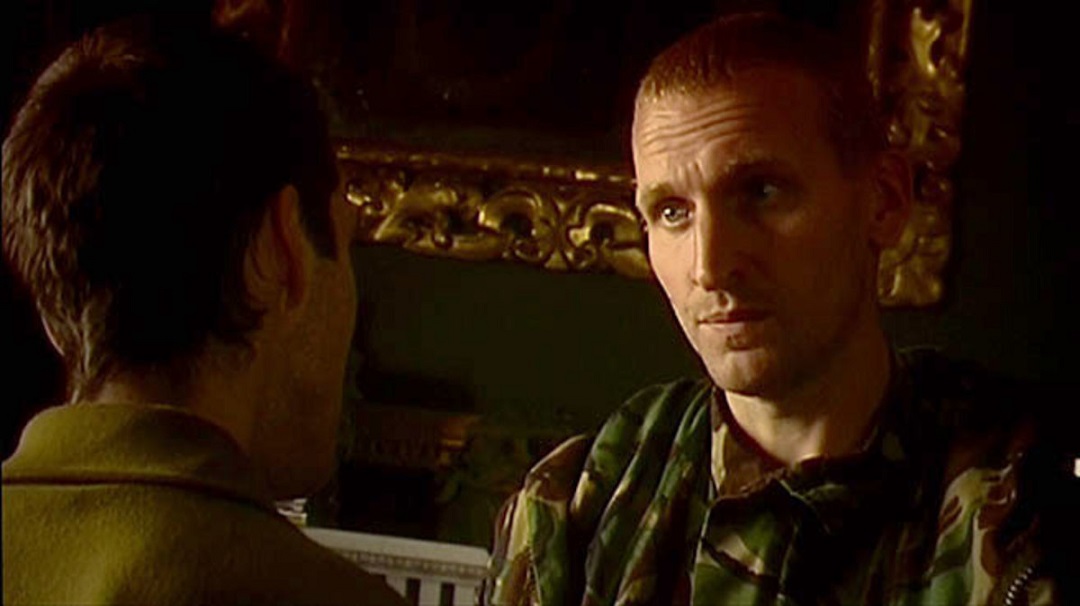
While not a star-studded cast, at least at the time, everyone turns in fully committed work, and both leads would go on to bigger projects following this film. Naomie Harris would go on to co-star in both the Pirates of the Caribbean and James Bond franchises, and would score a Best Supporting Actress Oscar nomination for her performance in Moonlight. Cillian Murphy would go on to become a Christopher Nolan regular, most notably as a villain in the director’s Dark Knight trilogy and Oppenheimer, the latter of which won him the Oscar for Best Actor.
As Jim, Murphy gives a breakout performance, perfectly capturing the everyman’s initial confusion and vulnerability that gradually evolves into determination and resolve for hope as the events unfold. Harris wonderfully subverts the the damsel in distress role on its head, grounding Selena’s tough, badass attitude with a very human sense of fear and distrust. As the cold-blooded Maj. Henry West, Christopher Eccleston embodies the film’s true horror born out of humanity’s collapse. Eccleston remains chillingly subdued throughout his performance, effectively dialing up the tension and unease through restraint instead of villainous theatrics.
Brendan Gleeson, along with Eccleston, was arguably the biggest name attached to the film at the time of its release, and brings an invaluable veteran presence to Frank. There’s an immense warmth and tenderness to Gleeson’s performance that never comes off too twee or mawkish, particularly during the scenes between him and his daughter Megan. His ability to create such an empathetic portrayal is what makes Frank’s final moment with his daughter so incredibly heart-wrenching.
Closing Statement: Energized by strong performances, an oppressively unsettling atmosphere and Danny Boyle’s frenzied style, 28 Days Later combines terrifying zombie horror with even more terrifying political allegory and, to this day, remains the most influential zombie film of the 21st century.
Silver Screen Fanatic’s Verdict: I give 28 Days Later an A+ (★★★★).
Benjamin’s Stash Tier: Diamond Stash
About Post Author
